What does a product line do?
Product lines provide quick and accurate insight into the sales and overall demand for rotational SKU products, without the need to create pivot tables in Excel. A product line:
- Groups rotating, strain-based SKUs into logical product lines (e.g. Brand X - Live Resin Carts – 1g)
- Accounts for strain rotation, package changes, and SKU churn
- Calculates true demand even when individual SKUs rotate in/out
Benefits
- Solves the “strain churn” problem in cannabis
- Makes ordering faster and more accurate
- Enables consistent product line shelf presence without overbuying
Why use product lines to order strain-based products?
Strains rotate and change out. Overall demand for that product type stays steady.
Up to 80% of cannabis products are strain-based. That includes flower, prerolls, vapes, and concentrates.
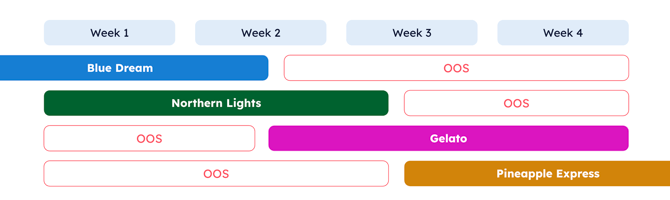
Strains for these products come and go all the time, and customers roll with it. If Blue Dream is gone, they grab Northern Lights. The strain changes, but the total number of people buying that product stays about the same.
This is called substitution, and it changes what your sales data is really saying.
A real example: one vape cart line, 30 days
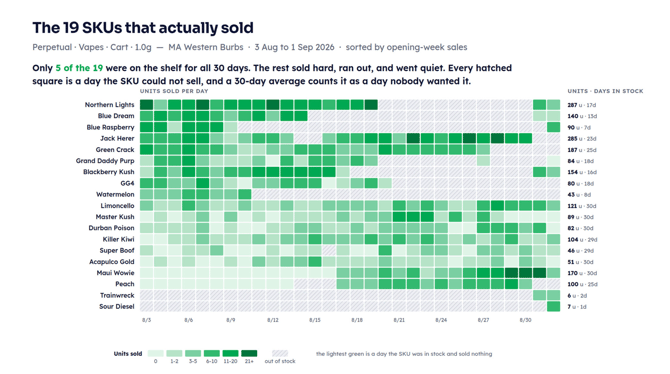
We looked at a month of sales for a popular 1g vape cart line. Here's what we found:
- A first group of strains sold well early in the month, then sold out.
- A second group was in stock the whole time but barely moved at first. Some may have been in the back.
- Once the first group sold out, the second group took off. Customers simply shifted to purchasing what was left.
Look at each strain on its own and every one of them looks like a strong seller. But those strong weeks happened at different times. They overlapped.
Add up each strain's best sales pace and the "demand" for the line looks much bigger than what customers actually bought. Reorder every strain to match, and the order grows fast.
What this does to sell-through on individual SKUs
Sell-through, or units per day, tells you how quickly inventory moves. At the SKU level, it can be misleading:
- A strain that sold out fast may have just had the shelf to itself.
- A strain that sat for weeks may have been waiting its turn.
- Neither number tells you how much to buy next.
When each strain gets reordered on its own numbers, you end up with more strains than customers need. They compete for the same shoppers (cannibalization), everything moves slower, and inventory starts to age. Retailers who reorder strain by strain are often overstocked by 20 to 30%.
That's why Happy Buyers orders using demand at the product line level.
A product line groups the strains of the same product together to calculate accurate demand. Same brand, same category, same product type, same size.
For example:
- Baby Jeeter 5pk x 0.5g Rosin Infused Prerolls
- 3.5g Indica House Flower
- STIIIZY 0.5g Live Rosin Vape Cart
- Live Resin AIO 1g Vapes
When you look at the line's combined sell-through, the overlap disappears. You see the real pace customers buy at, no matter which strains happened to be on the shelf.
Strain-level data is still useful! It's great for comparing which strains your customers like best. But it's important to us the product line sell-through when deciding how much to buy.
Viewing your product lines
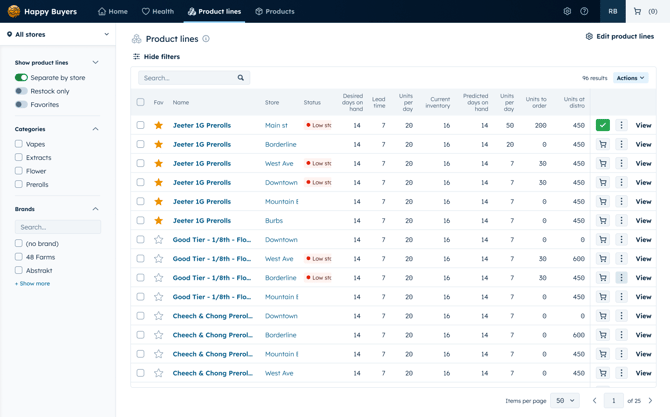
The Products lines page gives you clear visibility to all of your product line data in a sortable table. This is great for comparing sell through rates of similar product lines and total inventory levels across brands and stores.
Toggle Separate by store on or off, to view the sell through at the store level or to view the sell through rolled up across all locations.